
A Corolla burns gas too.
It sounds obvious written down, but it is the piece everybody forgets when they compare two window stickers.
You look at 36,000 $ on one side, 43,000 $ on the other, you conclude the electric one costs more, and you stop counting there. Except the gas car, you keep paying for it every single week for ten years.
So I did the whole calculation. New series: what it actually costs, segment by segment. We start with the compact. Quebec numbers, Canadian dollars.
THE THREE CARS
Toyota Corolla XSE CVT 2026, the loaded trim. 36,174 $ before tax, all in, freight and delivery included. Price pulled from Toyota Canada’s own configurator.
Toyota Corolla Hybrid XSE AWD 2026. 40,295 $ before tax. I include it because it is the first objection I am going to get, and I would rather answer it before it is asked.
Chevrolet Bolt LT 2027. 39,999 $, plus 2,600 $ freight, 699 $ dealer fees, 100 $ air conditioning levy and 27 $ tire levy. Total 43,425 $ before tax, delivered in Laval, according to Chevrolet Canada’s configurator.
I was going to use the Model 3. But since October 12, Tesla has stopped taking Model 3 Premium orders in Canada. Its site says its import quota from China is used up, and that ordering resumes if Ottawa issues more quota, or in March 2027. A car you cannot order is no use in a calculation for someone shopping this fall. The Bolt can be ordered today, and there is inventory around Laval.
I will also say what someone is going to bring up: GM has described the Bolt as a limited-run model, about a year and a half of production. It changes nothing in the math, but now you know.
THE ASSUMPTIONS, SO YOU CAN ARGUE WITH ME
20,000 km a year, for 10 years. Taxes included throughout, 14.975 % here in Quebec.
Gas at 2.00 $ a litre. That is the real price: Quebec’s energy board logged 201.7 cents average for the Montreal region for the week of October 5.
Corolla consumption: 7.5 L/100 km in real use. I will hand you the two competing numbers right now, you would have found them anyway: Natural Resources Canada rates it 6.7 to 6.8 combined, and Consumer Reports measured 6.53 on track and road. At 6.53, my final saving drops to about 6,000 $ instead of 10,000. Pick your number, I am giving you both.
Electricity: the US EPA rates the Bolt at 17.5 kWh/100 km. I bump it to 21, 20 % more, for winter and real driving. That is a bigger gap than I give the Corolla, on purpose. And I use 0.25 $ per kWh, deliberately high. At home, Hydro-Québec’s residential rate is 11.142 cents in the second tier, about 12.8 cents with tax. Quebec’s public fast chargers run 0.38 $ to 0.62 $ depending on power, tax included. So my 0.25 $ assumes you do a lot of fast charging. That is like doing about a third of your charging at 0.50 $ fast chargers, and the rest at home. If you charge mostly at home, you pay less than what I wrote.
And I am adding the 125 $ annual registration contribution on electric vehicles, which starts on fees payable after 31 December 2026 and is indexed after that. Over nine of the ten years, that is 1,219 $. It is in my table. It would have been easy to leave out.
THE TABLE
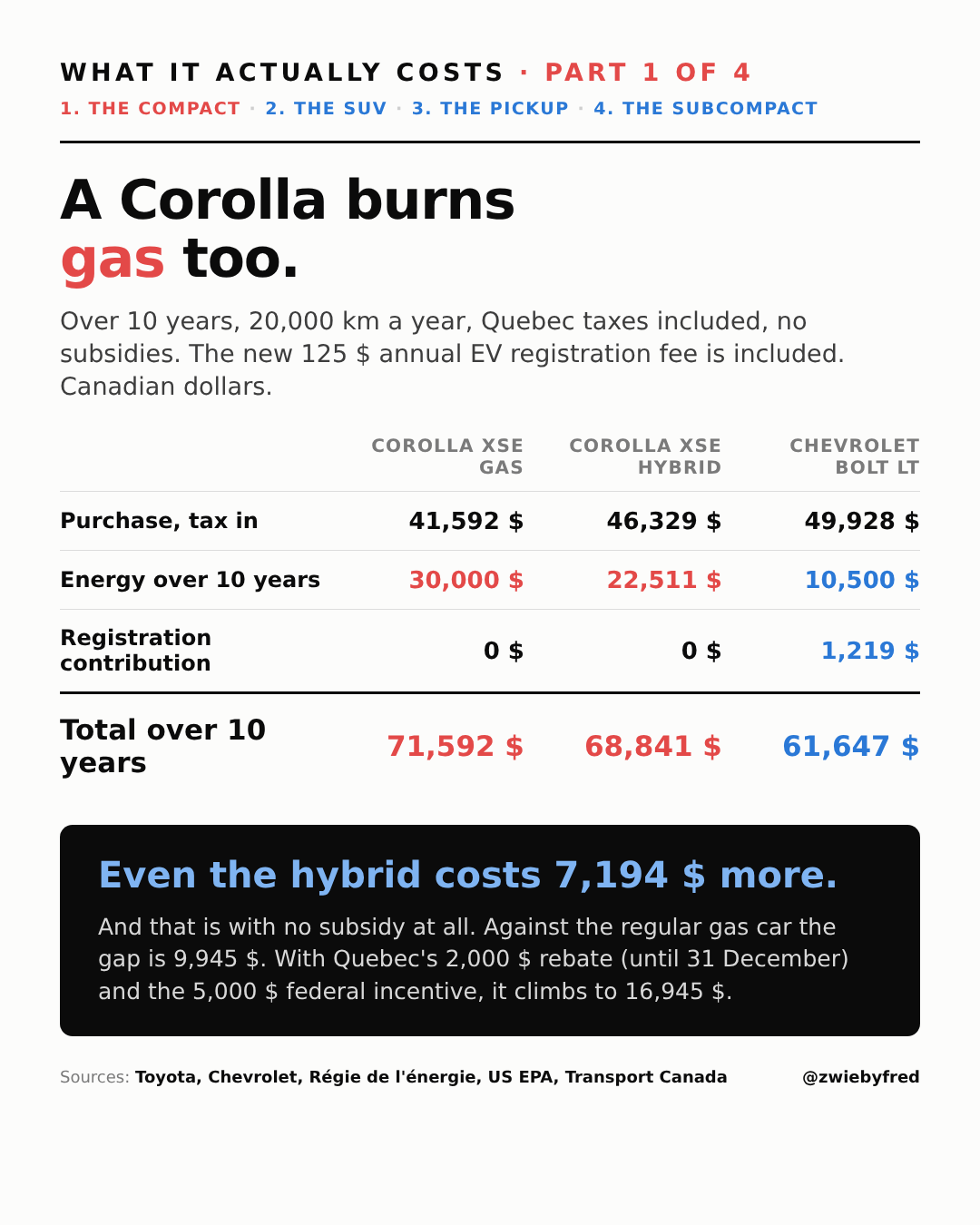
Corolla XSE gas Purchase, tax in: 41,592 $ Gas over 10 years: 30,000 $ Total: 71,592 $
Corolla XSE hybrid Purchase, tax in: 46,329 $ Gas over 10 years: 22,511 $ Total: 68,841 $
Chevrolet Bolt LT Purchase, tax in: 49,928 $ Electricity over 10 years: 10,500 $ Registration contribution: 1,219 $ Total: 61,647 $
You save 9,945 $ against the gas car. And 7,194 $ against the hybrid.
Not one cent of subsidy in there. Even the hybrid, the one everybody offers up as the reasonable compromise, costs seven grand more over ten years.
A word on that hybrid, because I want to be fair to it: I applied the same gap between official rating and real use that I applied to the regular Corolla, which gives 5.63 L/100 km. Otherwise I would be comparing real-world consumption on one side and a lab rating on the other, and that is exactly the kind of thing that derails this sort of comparison.
AND THERE ARE 64 DAYS LEFT
Quebec’s purchase rebate is not dead. It still pays 2,000 $ on a full electric vehicle, and it ends on 31 December 2026. Zero in 2027. Registration date is what counts, not order date.
And the Bolt qualifies for the federal program. The Electric Vehicle Affordability Program pays 5,000 $ at the point of sale in 2026 and 4,000 $ in 2027, and the Bolt is on Transport Canada’s official list. The program requires a car built in Canada or in a country with a free trade agreement with Canada. The Bolt comes out of Kansas, so it qualifies.
With both, 7,000 $ in all, the saving climbs to 16,945 $ against gas and 14,194 $ against the hybrid.
One correction while I am here, because stale information is still circulating: the federal iZEV incentive is not suspended, it ended on 31 March 2025. This new program replaced it on 16 February 2026.
WHERE THE MONEY GOES
The 30,000 $ of gasoline leaves Quebec. The 10,500 $ of electricity does not. Hydro-Québec paid a 2.2 billion dollar dividend to the provincial government in 2025, on net income of 2.9 billion.
I will be precise, though, because someone will call me on it: the Bolt is not built in Quebec. The energy is made here, not the car. But on the Corolla, gas is 42 % of the ten-year bill, and that is the share that leaves.
WHAT IS NOT IN THE TABLE
No oil changes. No spark plugs, no belts, no muffler, no exhaust system, no transmission to rebuild. Brakes that last far longer because of regenerative braking.
I am not putting a number on those, because I have no solid source for ten years of maintenance costs in Quebec, and I do not invent figures. But everything missing from the table leans the same way.
And if you drive more than 20,000 km a year, the gap grows. At 30,000 km it is 19,695 $. At 40,000, it is 29,445 $.
Next in the series: the compact SUV. A gas CR-V, a RAV4 hybrid and a Model Y. That one is the real market.
Part 1 of 4 in the series What it actually costs.
Sources: Toyota Canada, Chevrolet Canada, Tesla Canada, Régie de l’énergie du Québec, Hydro-Québec, Circuit électrique, Quebec Ministry of Finance (Budget 2025-2026), Québec.ca, Transport Canada (EVAP), Natural Resources Canada, US EPA, Consumer Reports.